


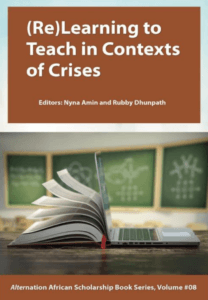
(Re)Learning to Teach in Contexts of Crises
Editors: Nyna Amin and Rubby Dhunpath (Eds.)
Publisher: CSSALL Publishers (Pty) Ltd
Synopsis: This book arose from an invitation to contribute a volume on the impacts of COVID-19 on higher education institutions by the Editor-in-Chief of Alternation. We received close to sixty manuscripts. Twenty-seven were sent out for double-blind peer review and a final selection of fifteen was made. The chapters cover a range of issues pertinent to higher education and the authors include recent PhD graduates, postdoctoral fellows, and experienced social scientists and philosophers. The number of submissions gives a clear indication of the influence of the current conditions on higher education knowledge production. It is our belief that this body of scholarship adds value to our understanding about teaching during a crisis and beyond that, to unexpected conditions that will arise without forewarning in years to come. Its contribution is pertinent for our emotional and cognitive well-being because it is evidence of resilience, and deep and insightful learning that those in higher education have gained – and more importantly, that it does not matter where, and when the (re)learning, learning and unlearning takes place. It matters that all kinds of learnings are taking place and are worth sharing. We do not offer a commentary on each chapter. Instead, we leave it to readers to interpret the texts based on their own contexts, and philosophical, conceptual and theoretical preferences. However, we must declare, that the first chapter by Amin, Dhunpath and Devroop, outlines conceptually and theoretically the notion of ‘(re)learning to teach’ as a problematic imperative emerging from the pandemic-generated crisis. It is not a conception that we imposed on the authors. We provided a wide berth for interpretation of the notion. Furthermore, there was no expectation for a particular paradigm or ideology despite our preferences for critical, poststructural and deconstructive worldviews. With more than seven billion individuals inhabiting the planet, it would be foolish to imagine that particular worldviews should dominate the interpretation and analysis of our inquiries. The inclusion of the Spivak chapter in a format that differs from the rest in the compendium reflects our commitment to dissension. We chose not to amend the chapter for the sake of uniformity as its impact and power is expressed in the style the author is renowned for. We think you will agree with our decision. In keeping with the editors’ minimalistic approach, we chose not to thematize the chapters or to place them within sections. Each chapter, readers will note, raises multiple issues and concerns, and the restrictions placed by themes and sections undermine complexity and connectivity. As a result, the sequencing of chapters is based on the logic (and convenience) of the alphabetical order convention (of the first author in each case). The chapters are interesting takes and include philosophical posturing and case studies in a variety of contexts and countries. We would like to acknowledge the assistance of Dr. Laura Campbell for overseeing the peer review process, Dr. Connie Israel and Ms. Barbara Kabange for the language editing of the texts, Mr. Abdulbaqi Badru (PhD candidate) for the cover design, and Prof. Chats Devroop for formatting all chapters and assisting with troubling matters of the ‘technology kind’.
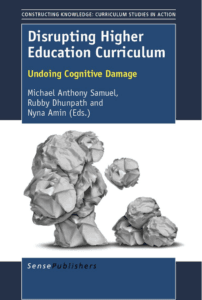
Title: Disrupting Higher Education Curriculum: Undoing Cognitive Damage
Editors: Michael Anthony Samuel, Rubby Dhunpath and Nyna Amin (Eds.)
Publisher: SensePublishers
Synopsis: Discomfort with the inappropriateness of university curricula has met with increasing calls for disruptive actions to revitalise higher education. This book, conceived to envision an alternative emancipatory curriculum, explores the historical, ideological, philosophical and theoretical domains of higher education curricula. The authors acknowledge that universities have been and continue to be complicit in perpetuating cognitive damage through symbolic violence associated with indifference to the pernicious effects of race categorisation, gender inequalities, poverty, rising unemployment and cultural hegemony, as they continue to frame curricula, cultures and practices. The book contemplates the project of undoing cognitive damage, offering glimpses to redesign curriculum in the 21st century. The contributors, international scholars, emergent and expert researchers, include different nationalities, orientations and positionalities, constituting an interdisciplinary ensemble which collectively provides a rich commentary on higher education curriculum as we know it and where we think it could be in the future. The edited volume is a catalytic tool for disrupting canonised rituals of practice in higher education. “It has been a while since a scholarly book, so authoritative in its claims and innovative in its concepts, threatens to shake up the curriculum field at its foundations. Rich in metaphor and meaning, the superbly written chapters challenge a field that once more became moribund as we settled (sic) far too comfortably into accepting handed-down frames and fictions about knowledge, authority, power and agency that imprint “cognitive damage” on those forced to the margins of schools and universities. Disrupting higher education curriculum demonstrates, however, that it is in fact from those margins of the education enterprise that academics, teachers and learners can see more clearly how patterns of thought and action hold us back from placing and experiencing our African humanity at the centre of the curriculum.” – Jonathan Jansen, Rector and Vice Chancellor of the University of the Free State, South Africa

Teaching & Learning in the College of Management Studies: Shared Approaches, Lessons & Good Practices
Compiled and Edited by: Kriben Pillay and Fiona Farquharson – Foreword by: Professor John Mubangizi
Published: October 2014
Synopsis: “This volume is a timely addition to a growing literature and scholarship in teaching and learning in what may be referred to as the professional disciplines and programmes. The range of chapters provide a mosaic of theoretical and practical reflections: from pedagogy, assessment and issues of access; to practitioner research in management and related areas. It should be read by all academics who are involved and interested in advancing student success through innovative curricula and approaches, and will no doubt inspire further research ideas.” – Professor Renuka Vithal, DVC: Teaching & Learning
Click here to Download e-Book (PDF).
Funding Higher Education in Sub-Saharan Africa
Edited by: Damtew Taferra – Foreword by: Philip G. Altbach
Publisher: Macmillan – 2013
Synopsis: Drawing on in-depth, evidence-based research from nine countries, this volume sets out a comprehensive analysis of financing patterns currently being adopted by institutions across Eastern and Southern Africa to help accommodate the rapidly growing number of enrollments and massification of education. This book makes an impressive contribution to two key areas of Africa’s higher education development: a better understanding of patterns of funding and the need to improve deeper research on African higher education.

Alternative Access to Higher Education: Underprepared Students or Underprepared Institutions?
Edited by: Rubby Dhunpath & Renuka Vithal
Publisher: Pearson – 2013
Synopsis: In response to the access and equity imperative in South Africa, universities have introduced a variety of access programmes, the most common of which are the state-sponsored Foundation Programmes, the success of which has never fully been investigated to assess their efficacy and impact. Based on empirical work of acknowledged experts in alternative access and Foundation provisioning in South Africa and using the University of KwaZulu-Natal as a case study, this books shifts the gaze, placing under scrutiny the question of institutional (under) preparedness.
Some of the main questions that authors ask in the book are:
Archaeology of a Language Development NGO: Excavating Organisational Identity
Author: Rubby Dhunpath – 2010
Publisher: LAP Lambert Academic Publishing
Synopsis: NGOs that provide alternative education and literacy development in response to discriminatory education systems are known for their contextually responsive interventions to counter the effects of structural inequities. This book documents the institutional memory of a South African NGO, the Environment and Language Education Trust (ELET), portraying two decades of its history through the eyes of key individuals. It traces the multiple internal and extraneous influences that shaped the NGO?s mutating identity as it negotiated the challenges of an unpredictable NGO climate and volatile political regime. The book interrogates the potential of an institutional biography as an alternative evaluative tool,finding that while ELET has been complicit in allowing its mission as a counter- hegemonic agency to be undermined by its submission to normative, coercive and mimetic isomorphism, it nevertheless demonstrates agency to innovate rather than replicate, benefiting from astute management and a vigilant quest for home-grown intervention programmes which helps it redefine what constitutes emancipatory literacies in a developing country.

Editors: Rubby Dhunpath & Michael Samuel
Publisher: Sense Publishers – 2009
Synopsis: Much has been written about lifehistory research in recent times. It has been paraded as a counterculture to the traditional research canon, and celebrated as a genre that promotes methodological pluralism. However, lifehistory researchers have an obligation to transcend spurious claims about the perceived merits of the methodology and extend the debates around how the genre simultaneously problematises and responds to the competing challenges of Epistemology, Methodology and Representation. In conceiving of each of the chapters from an epistemological perspective, the authors focus on how their individual work has crossed or expanded traditional borders of epistemology and ontology; of how the work has satisfied the rigours of thesis production and contributed to changing conceptions of knowledge, what knowledge gets produced and how knowledge is produced when we make particular methodological choices. Since any methodological orientation is invariably selective, and the researcher is always involved and implicated in the production of data, the authors focus on what selections they have made in their projects, what governed these choices, what benefits/deficits those choices yielded, and what the implications of their research are for those meta-narratives that have established the regimes of truth, legitimacy, and veracity in research. Knowledge production is inextricably linked to representation. In the process of articulating their findings, each author made particular representational choices, sometimes transgressing conventional approaches. The book explores why these choices were made and how the choices influenced the kinds of knowledge generated. The book provides theoretical justifications for these transgressions and reflect on how the experience of representation helped disrupt the authors’ essentialist notions of research production and for whom it is produced. This book is not another celebration of lifehistory as a counterculture. The book hopes to be a deeply critical contribution to disrupt notions around epistemological authority, voice and power and how these are mediated by the delicate relations of the researcher and researched. The problematises and complicates the assumptions that frame this genre with a view to highlighting the potential hazards of the method while demonstrating its potentiality in shaping our conceptions of Ethics, Methodology and Representation.

Researching Possibilities in Mathematics, Science and Technology Education
Author: Kgeti Setati – Editors: Kgeti Setati, Renuka Vithal, Cliff Malcolm & Rubby Dhunpath
Publisher: Nova Science Publishers Inc. – 2009
Synopsis: Mathematics, Science and Technology Education (MSTE) emerged as a research discipline in the 1960s, and continues to reflect the distinctive flavour and character of its roots in Western societies, and science. In this mode, often based on positivist frameworks, research environments are characterised by idealised environments, sanitised research conditions; depoliticised neutralised data and contested analyses. The book arises from needs in the mathematics and science education research community in Southern Africa for a methodology text that is responsive to rapidly changing educational environments; and to the challenges and possibilities of research in contexts characterised by inequality, diversity, poverty, violence, the particular history within which research takes place, and the consequent ethical and socio-political considerations.The book also acknowledges and works with the practical and political realities of education and schooling in much of Southern Africa, where schools are often poorly resourced and communication with them is often difficult, and where research methodologies and ethics have to take account of the complexities of school operations and school-community relationships. The book does not aim to position itself as a counterpoint to ‘conventional’ research methodologies. It aims to build on the established base of mainstream MSTE and seeks to elevate and widen the debates, raise methodological issues, and offer innovative possibilities and pedagogies.To this end, the chapters present theoretical, meta-level reflections on issues in research design in the fields of mathematics, science and technology education. In this shift of focus, the book draws on a number of fairly recent research approaches. These include ethno mathematics, cultural studies in science education, place-based education, community-based education, environmental education, socially critical theory, and education for social and economic development.
Learner-Centered Science Education
Author: Cliff Malcom Editor: Rubby Dhunpath
Publisher: Sense Publishers – 2008
Synopsis: This book arises from the author’s experience of the South African science curriculum development and teaching since 1994, exploring definitions of science and approaches to science education appropriate to a newly liberated developing country. Each of the 50 chapters is borne out of Cliff Malcolm’s close relationships with communities in SA where he obtained deep insights into their attitudes to science teaching and learning, providing him with an empirical basis to challenge tertiary institutions to transform their curriculum offerings to embrace the culture and world views of African students. The author makes a compelling case for the evolution of relevant science teaching and learning that provide ‘capital’ for indigenous knowledges. The book has relevance also to first world countries, because the social and educational problems facing South Africa, though starker here, are present in all countries. The book addresses, among others, the nature of scientific knowledge and knowledge productiona; how scientific knowledge can be accessed and represented; what counts as legitimate scientific knowledge in the South African context of colonization, liberation, inequity and African belief systems. The book extends the debates on “African” Science, and offers ways of talking and writing about science that reframe it, acknowledging problematics and pluralism, offering ways of bringing Western and African thought together. Using a richly descriptive novelistic style, the author sketches vivid portraits of his research sites, participants and experiences. His vignettes are embedded in deep theoretical insights, lending gravity to the development discourse in science education, providing a coherent language for the transformational agendas of science educators committed to the project of social justice through a relevant science.